Home · The Journal · Kids' Table and Chair Heights by Age
Kids' Table and Chair Heights by Age
The question we are asked more than any other: what size table and chairs do children actually need? Here is the answer, age by age, with the one measurement most people miss.
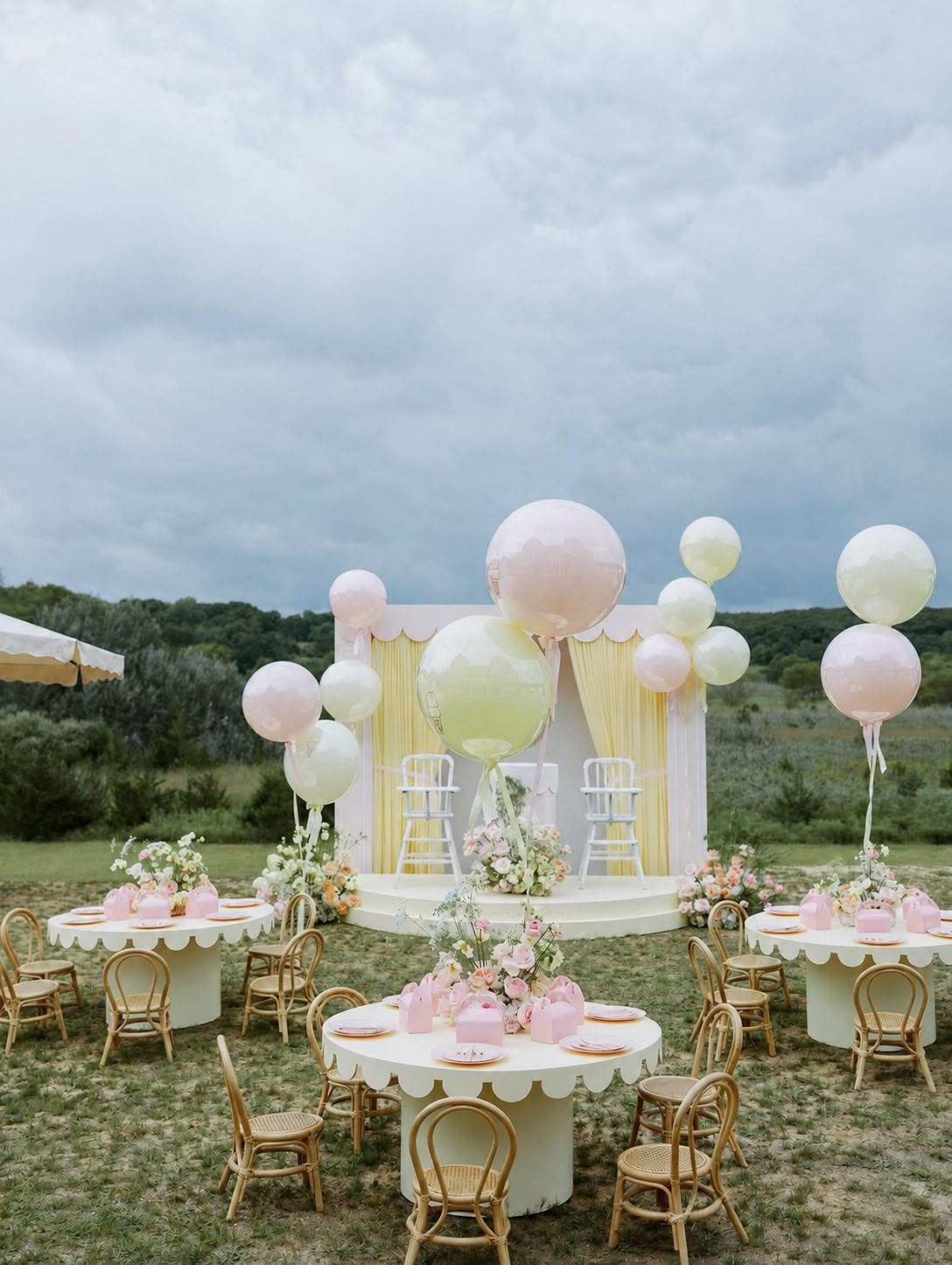
Need the right size delivered? We rent every height on this chart and set it up for you across NJ & NY: toddler table and chair rental for ages 1–3, and kids table and chair rentals for ages 3–8. Tell us the ages and we size it — get a quote.
Parents almost never ask us about color first. They ask whether the chairs will actually fit their three-year-old, or whether a six-year-old will look silly perched at a toddler table. It is a fair question, and the answer is more precise than most party inspiration accounts let on. Children's furniture is sized in fairly narrow bands, and getting within an inch or two of the right band is the difference between a table where children sit happily for twenty minutes and a table they slide off after four.
Here is the guidance we use when a family tells us the ages of the guests, along with the reasoning behind it, so you can measure what you already own and decide what is worth renting.
The short answer: heights by age
These are the ranges children's furniture is manufactured to, and the ones we work from:
- Ages 1 to 3 — table about 15 inches tall, seat about 7 inches off the floor. This is the smallest size in regular use, and it is the one most often skipped. A two-year-old at a 20-inch table is eating at chin height. If your guests are mostly this age, we rent that size: see toddler table and chair rentals in NJ.
- Ages 4 to 6 — table about 20 inches, seat about 12 inches. This is the workhorse size for birthday parties, because most guest lists at that age skew four to six even when the birthday child is three or seven.
- Ages 6 to 9 — table about 22 inches, seat about 14 inches. Older children need legroom more than they need a low seat, and a 22-inch table gives it to them without looking like grown-up furniture.
- Ages 10 and up — at this point a standard dining height, roughly 29 to 30 inches with an 18-inch seat, is usually the kinder choice. A ten-year-old folded into a child's chair for an hour is not comfortable, however charming it looks in photographs.
Kids' table and chair height chart by age
| Age | Table height | Chair seat height | Seat-to-table gap |
|---|---|---|---|
| 1–3 (toddler) | about 15″ | about 7″ | 5–6″ to the underside of the top |
| 4–6 (preschool) | about 20″ | about 12″ | 5–6″ |
| 6–9 (school-age) | about 22″ | about 14″ | 5–6″ |
| 10 and up | 29–30″ (standard dining) | about 18″ | standard adult fit |
Mixed ages at one party? Seat the youngest guests at their own toddler-height section, or let us mix heights at one table so every child's feet reach the floor.
The measurement most people miss: the seat-to-table gap
Table height on its own tells you very little. What matters is the distance between the top of the seat and the underside of the tabletop. For children that gap wants to be about 5 to 6 inches. Less than that and knees hit the apron; more than that and small arms have to reach up to the plate, which is exactly when cups go over.
Check it with a tape measure in ninety seconds: measure from the floor to the top of the seat cushion, then from the floor to the underside of the table where a child's knees would go, and subtract. If you land between five and six inches, the pair works, whatever the marketing on the box said. If you are at three inches, the chairs are too tall for that table; at eight inches, they are too short.
The second check is the feet. A child whose feet dangle will fidget, and fidgeting at a table full of cups ends the way you expect. Ideally the soles rest flat on the floor with the knees at roughly a right angle. If the chair is a touch high, a flat cushion under the feet is a perfectly respectable fix for a two-hour party.
How wide does the table need to be?
Plan on about 20 to 24 inches of table edge per child. That is enough for a plate, a cup and a set of elbows without the child next door getting an elbow in the ribs. Round tables are more forgiving than long rectangles for younger children because everyone can see everyone, and because there is no head of the table to argue over. Our Daisy Table, for example, is 36 inches across and seats five comfortably, which is exactly that math: a circle of 113 inches of edge, shared five ways.
Depth matters too. If a table is narrower than about 24 inches, two children sitting opposite each other will bump plates. That is fine for a craft table and irritating for a meal.
Seating a table of mixed ages
Almost every birthday has a spread: the birthday child's friends, a couple of younger siblings, an older cousin. You have three good options and one bad one.
Option one: size to the middle and adapt at the edges. Set the table to the largest age group and bring a booster or a high chair for the youngest. This is what most families end up doing, and it works well as long as the youngest is not left at a table where their chin is level with the plate.
Option two: two tables, two heights. If the ages split cleanly — say five three-year-olds and five seven-year-olds — two round tables at two heights, styled identically, reads as a design decision rather than a compromise. Children also tend to settle faster when they are seated near their own age group.
Option three: one table, and a plan for the baby. A high chair pulled up to the same table keeps the youngest in the photographs and out of the traffic path. Our Isabella high chair exists for exactly this — a first birthday where the baby sits at the table rather than beside it.
The option to avoid: adult folding chairs at a children's table. They are too tall, too wide, and they turn a styled table into a school cafeteria. If you have run out of small chairs, it is better to have children share a bench than to bring in a folding chair.
Counting chairs, not just sizing them
A quick rule that has held up over hundreds of parties: seat about 75 percent of the children on your list. At a two-hour party, children rotate through the table — some are at the craft station, some are outside, a few are with a parent. Seats for every single name on the invitation almost always means a table with empty chairs in every photograph. We wrote this out in more detail in our guide to how many chairs and tables a kids' party needs.
The exception is a seated activity — a cookie decorating table, a craft, a sit-down lunch. For those, count every child, because they all arrive at once.
What we bring, and how we match it
Our collections — Essential, Classic and Atelier Rattan — are all built to children's proportions rather than shrunk-down adult dimensions, and tables can be customized on request in any color or size to match a theme. The one exception is the M.C.A Lego Table, which arrives around the middle of October and comes exactly as it is.
When you send a date, tell us the ages of the guests as well as the number. That one line changes what goes on the truck. A table of two-year-olds and a table of seven-year-olds are not the same party, and they should not arrive with the same furniture. Everything is delivered, set up and picked up the next day across New Jersey, New York, so the sizing is our problem rather than yours.
A ninety-second checklist before you book
- Write down the ages of the children, not just the headcount.
- Measure the seat-to-table gap on anything you already own — aim for 5 to 6 inches.
- Allow 20 to 24 inches of table edge per child.
- Decide whether the party is seated (count everyone) or roaming (count about three quarters).
- Plan a seat for the youngest guest, even if it is a high chair pulled up to the table.
- Measure the doorway and the path to the yard — a table that fits the guests but not the gate is still a problem.
Get those six lines right and the rest — the linens, the place cards, the cake table — is styling. Get them wrong and no amount of styling rescues a table children will not sit at.
Frequently asked questions
What height table do 3-year-olds need?
A table about 15 inches tall with seats about 7 inches off the floor suits most one- to three-year-olds. The key is a gap of about 5 to 6 inches between the seat and the underside of the table.
What is the right table height for a 5-year-old?
Around 20 inches, with a seat about 12 inches high. This is the most common size at children's birthday parties, since most guest lists at that age fall between four and six years old.
How much table space does each child need?
Allow 20 to 24 inches of table edge per child. That leaves room for a plate, a cup and elbows without crowding. A 36-inch round table seats five children comfortably.
What do you do when the guests are different ages?
Either size the table to the largest group and add a booster or high chair for the youngest, or set two tables at two heights styled identically. Avoid putting adult folding chairs at a children's table.
Do you rent chairs sized for toddlers as well as older children?
Yes. Our Essential, Classic and Atelier Rattan collections are all built to children's proportions, and tables can be customized on request. Tell us the ages of the guests when you send your date and we match the sizes for you.
Tell us their ages. We'll bring the right sizes.
Beautiful children's tables, chairs and dessert carts — delivered, set up and picked up across NJ & NY.
Call 917-682-1524